
Adult Vaccine Schedule: Which Vaccines You Need at Every Age Health News

Staying healthy as an adult takes more than the shots you received as a child. Immunity can fade over time, and the diseases that put you at risk at 55 are not the same as the ones that matter at 25. Following the adult vaccine schedule is how you keep protection current, from a yearly flu vaccine and tetanus boosters to shingles, pneumococcal, and RSV vaccines as you get older.
This guide walks through which vaccines adults are recommended to get at each stage of life, how often they repeat, and how to confirm exactly what you need. Recommendations are set by the CDC and can change, so use this as a starting point for a conversation with your provider.
Why Adults Need Vaccines at Every Age
Vaccines work by giving your immune system a safe rehearsal. Your body learns to recognize a germ, makes antibodies, and remembers the response so it can react faster if the real infection arrives. That protection is not always permanent. Tetanus protection needs a booster about every 10 years, and flu viruses change enough that a new vaccine is recommended each year.
Risk also changes with age. Shingles, pneumococcal disease, and severe RSV become bigger concerns as you get older, which is why several vaccines begin at age 50 or later. Many adults also have gaps they do not know about, such as a missing record from childhood or a booster that quietly lapsed.
Your Adult Vaccine Schedule by Age Group
The CDC organizes adult recommendations by age, then adds vaccines for medical conditions, pregnancy, work, and travel. The table below summarizes the age-based view from the CDC adult immunization schedule. An asterisk means the vaccine applies when you have no evidence of immunity.
| Vaccine | 19 to 26 | 27 to 49 | 50 to 64 | 65 and older |
|---|---|---|---|---|
| Influenza (flu) | Every year | Every year | Every year | Every year (high-dose, adjuvanted, or recombinant preferred) |
| Tdap or Td | Tdap once, then every 10 years | Every 10 years | Every 10 years | Every 10 years |
| MMR* | Yes | Yes | Yes | Yes |
| Varicella* | Yes | Yes | Yes | Yes |
| HPV | Through age 26 | Ages 27 to 45 after shared decision-making | Not routine | Not routine |
| Hepatitis B | Yes | Yes | Routine through age 59, then discuss | Discuss with your provider |
| Shingles (recombinant) | Only with certain immune conditions | Only with certain immune conditions | 2 doses from age 50 | 2 doses |
| Pneumococcal | Only with certain risk factors | Only with certain risk factors | 1 dose from age 50 | 1 dose if not previously vaccinated |
| RSV | Only during pregnancy | Only during pregnancy | Ages 50 to 74 with increased risk | All adults 75 and older; ages 65 to 74 with increased risk |
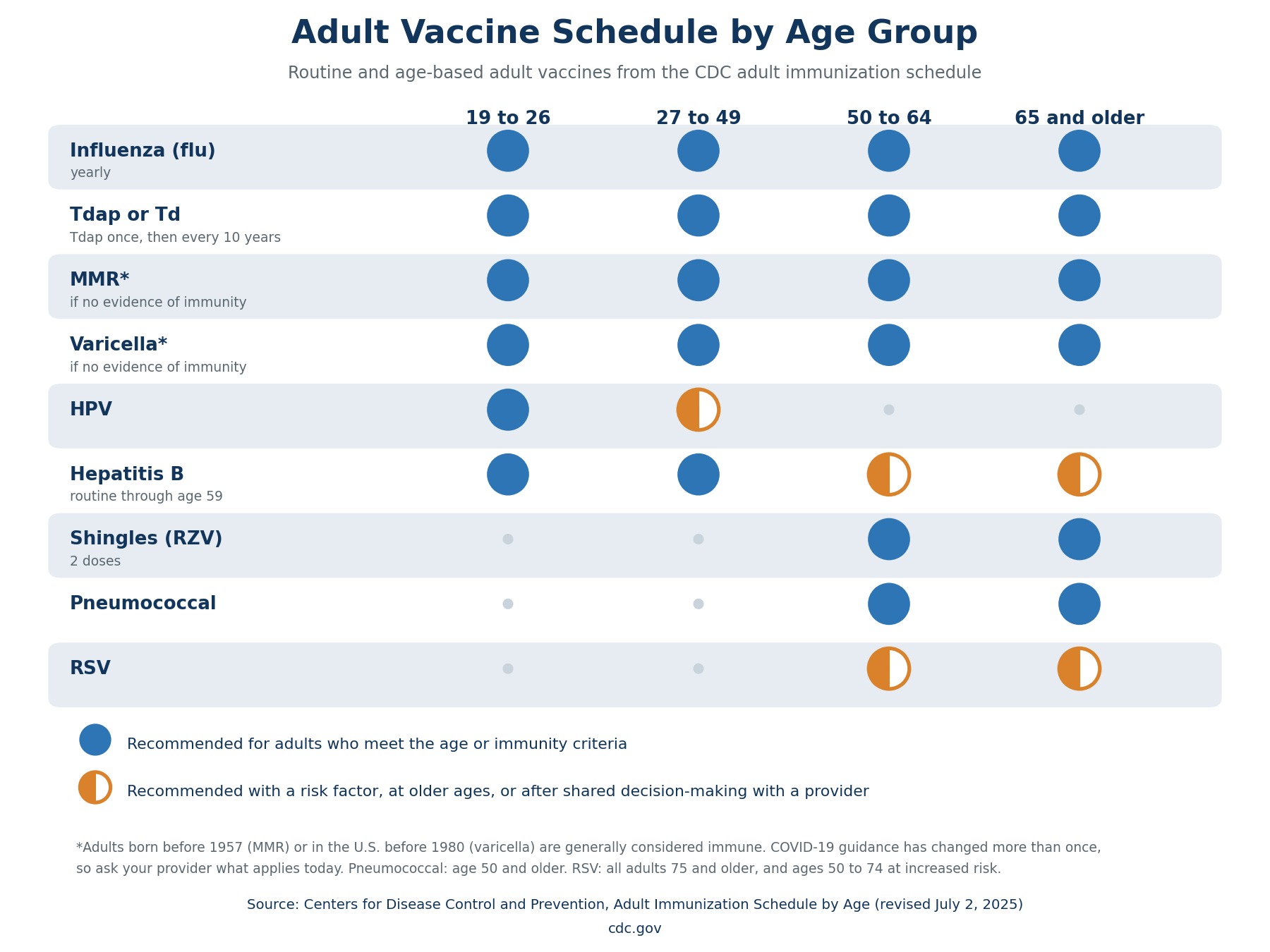
Source: CDC, Adult Immunization Schedule by Age
How to Use the Adult Vaccine Schedule With Your Provider
The schedule is a map, not a prescription. Your provider combines it with your personal history so you get the right vaccines, not extra ones. Bring the following to your visit:
- Any vaccination records you can find, including military, school, or workplace records.
- Your health conditions, since diabetes, heart disease, lung disease, and weakened immunity can add vaccines or change timing.
- Your job and travel plans, because health care, education, and international travel can add requirements or recommendations.
- Pregnancy plans, which affect timing for Tdap, RSV, and live vaccines such as MMR and varicella.
COVID-19 Vaccine Guidance Has Changed
Federal recommendations for COVID-19 vaccination have been revised more than once, including a CDC move toward individual-based decision-making in 2025. Because the guidance can change from season to season, ask your provider what applies to you now and check the current CDC schedule rather than relying on an older chart.
Core Vaccines Most Adults Should Discuss
Flu Vaccine: Every Year
Adults 19 and older are recommended to get one dose of an influenza vaccine appropriate for their age and health every year. Adults 65 and older are encouraged to use a high-dose, adjuvanted, or recombinant flu vaccine. People with an egg allergy can receive any age-appropriate flu vaccine.
Tdap and Td: Tetanus, Diphtheria, and Pertussis
Adults who completed the childhood series need a Td or Tdap booster every 10 years. If you never received Tdap as a teen or adult, one dose of Tdap covers whooping cough, which can cause a long, exhausting cough and can spread to infants who are too young to be fully vaccinated. Tdap is also recommended during each pregnancy.
MMR and Varicella: Check for Immunity
Adults with no evidence of immunity to measles, mumps, or rubella need at least one dose of MMR. Evidence includes being born before 1957, a record of vaccination, or a blood test showing immunity. For chickenpox, evidence of immunity includes being born in the U.S. before 1980, two documented doses, a provider-verified history of chickenpox or shingles, or lab proof. If your records are missing, ask about lab testing for immunity before repeating doses.
Hepatitis B: Routine Through Age 59
The CDC recommends hepatitis B vaccination for adults 19 through 59. Adults 60 and older with risk factors, such as diabetes, chronic liver disease, or certain exposures, should receive it, and any adult 60 or older who wants the vaccine can get it.
Vaccines for Adults Over 50
Age 50 is a turning point on the schedule. Several vaccines begin here because the immune system gradually becomes less responsive and some infections become more serious.
Shingles Vaccine From Age 50
Shingles happens when the chickenpox virus, which stays in your body after childhood infection, reactivates. It causes a painful, blistering rash and can lead to long-lasting nerve pain called postherpetic neuralgia. The recombinant shingles vaccine is given as 2 doses, 2 to 6 months apart, to adults 50 and older, even if you have already had shingles.
Pneumococcal Vaccine From Age 50
Pneumococcal bacteria can cause pneumonia, meningitis, and bloodstream infections. CDC now recommends pneumococcal vaccination for adults 50 and older, and the right product depends on what you have received before. Review the CDC pneumococcal vaccine recommendations with your provider so you get the correct formulation instead of whatever happens to be on hand.
RSV Vaccine at 75 and Older, or 50 to 74 With Risk Factors
RSV vaccine is recommended as a single dose for all adults 75 and older, and for adults 50 to 74 at increased risk of severe RSV, such as those with chronic heart or lung disease, diabetes with complications, severe obesity, or a weakened immune system. It is best given in late summer or early fall, ideally August through October.
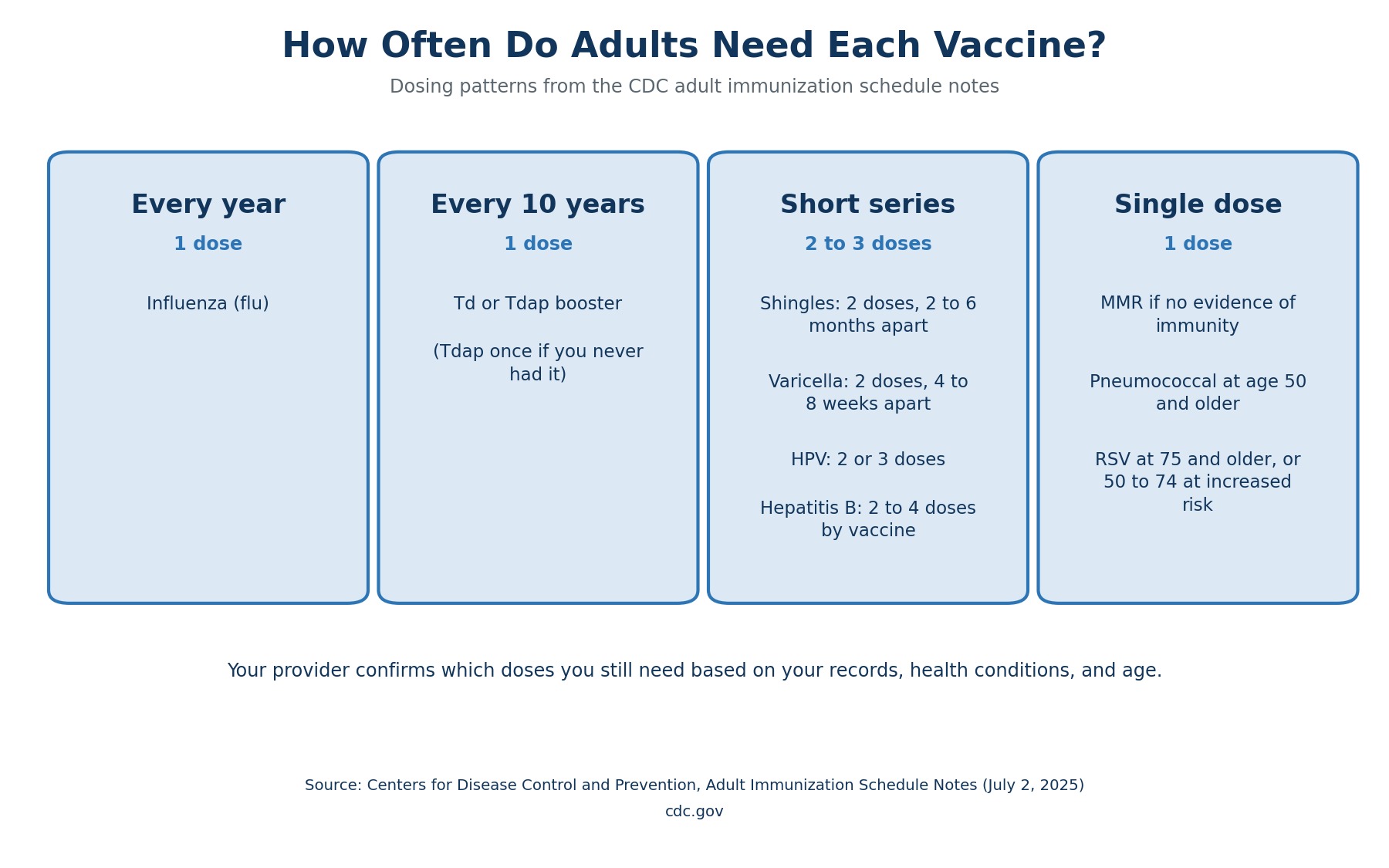
Source: CDC, Adult Immunization Schedule Notes
What If You Do Not Know Your Vaccination History?
Missing records are common and manageable. CDC guidance is to give recommended vaccines when a history is incomplete or unknown, and not to restart a series just because there was a long gap between doses. For some diseases a blood test can show whether you are already protected. Your provider can sort out which path fits you, and the CDC also offers an easy-to-read adult vaccine schedule you can review beforehand.
Workplace and Travel Considerations
Federal vaccine recommendations are not mandates. Some employers, particularly in health care, education, and childcare, may require certain vaccines, and international travel can add recommendations such as hepatitis A or meningococcal vaccines. Tell your provider about your job and travel so your plan reflects them.
Why a Primary Care Relationship Helps With Vaccines
A patchwork of pharmacy stops can leave gaps, because no one is tracking the full picture. A primary care team that knows your history can keep a running record, flag what is due, and adjust when your health changes. EBO MD membership includes an annual wellness visit, where the preventive review covers identification of preventive tests, procedures, and immunizations, plus unlimited visits for primary care needs. Your care team reviews your vaccination history, identifies what you are due for, and helps you plan the next steps. See primary care services for what everyday care covers.
Membership does not replace insurance. Many members keep insurance for emergencies, hospitalizations, imaging, and specialist care while using membership for day-to-day primary care. Review membership details and pricing or how the first visit works to see what to expect.
| Membership | Monthly rate |
|---|---|
| Adult (ages 19 to 64) | $99 |
| Senior (age 65 and older) | $75 |
| Child (ages 0 to 18), with at least one parent member | $10 |
Primary care visits carry no copays. If you want to build a broader preventive plan, the Have You Been Optimized e-book is a good companion, and members with questions can contact the care team anytime.
Four Clinic Locations in Southeast Missouri
Choose the clinic that fits your routine:
| Clinic | Address | Phone |
|---|---|---|
| Cape Girardeau primary care clinic | 1417 N Mount Auburn Road, Upper Level, Cape Girardeau, MO 63703 | 573-803-2941 |
| Jackson primary care clinic | 1334 Indian Parkway, Jackson, MO 63755 | 573-243-0750 |
| Fredericktown primary care clinic | 605 Lincoln Dr, Fredericktown, MO 63645 | 573-561-5051 |
| Poplar Bluff primary care clinic | 2725 North Westwood Boulevard, Ste 4, Poplar Bluff, MO 63901 | 573-872-4171 |
Frequently Asked Questions About Adult Vaccines
What vaccines do adults need?
Most adults need a flu vaccine every year and a Td or Tdap booster every 10 years. Other vaccines depend on age, health, and history: MMR and varicella if you lack immunity, HPV through age 26, shingles and pneumococcal vaccines starting at age 50, and RSV vaccine at age 75 and older or ages 50 to 74 with increased risk. Hepatitis B vaccine is routine for adults through age 59.
How often do adults need a tetanus booster?
Adults who completed the primary series and have had at least one Tdap dose need a Td or Tdap booster every 10 years. Adults who never received Tdap as a teen or adult should get one dose of Tdap, then Td or Tdap every 10 years.
At what age should I get the shingles vaccine?
The CDC recommends the 2-dose recombinant shingles vaccine for adults age 50 and older, given 2 to 6 months apart. It is recommended even if you have already had shingles or received the older shingles vaccine.
Do adults need the MMR vaccine?
Adults with no evidence of immunity to measles, mumps, or rubella need at least 1 dose of MMR vaccine. Evidence of immunity includes being born before 1957, documentation of MMR vaccination, or lab evidence of immunity. Some adults, such as college students, international travelers, and health care personnel, need 2 doses.
What should I do if I do not know my vaccination history?
Ask your provider to review your records. The CDC advises giving recommended vaccines when a history is incomplete or unknown, and a provider can also check for immunity to some diseases with a blood test. Series are not restarted just because time has passed between doses.
Are adult vaccines required?
Federal recommendations are not mandates. Some employers, especially in health care and education, may require certain vaccines, so check your workplace policy and ask your provider to help document your vaccination record.
How much does an EBO MD membership cost?
EBO MD adult membership (ages 19 to 64) is $99 per month, senior membership (age 65 and older) is $75 per month, and child membership (ages 0 to 18) is $10 per month with at least one parent member. Membership includes unlimited primary care office visits with no copays and an annual wellness visit.
Take Control of Your Preventive Health
You should not have to decode clinical guidelines alone. Bring your questions and any records you have, review the schedule with a provider who knows your history, and leave with a clear plan for what to get and when. This guide is educational and does not replace medical advice from your own provider.