
How to Pitch Direct Primary Care to Your Employer, Step by Step Primary Care

Learning how to pitch direct primary care to your employer starts with one idea: benefits decision makers respond to access, cost, and retention, not to frustration with a rushed appointment. Direct primary care (DPC) gives employees a membership with a primary care team that has time for them, and it gives employers a fixed price in place of a stream of claims. This guide covers what to say, which numbers to bring, and which questions to expect.
You do not need to be a benefits expert to make a persuasive case. You need a clear explanation of the model, an honest read of the research, and a low-risk proposal your employer can say yes to.
What Direct Primary Care Means for Your Workplace
In a DPC practice, patients pay a recurring fee, usually monthly, that covers most or all primary care services. The practice does not bill insurers visit by visit, and members generally pay no separate charge for services included in the membership. That structure is what allows longer visits, quicker scheduling, and direct communication with the care team.
How a DPC Membership Works With Major Medical Insurance
Direct primary care is a layer of coverage for everyday care, not a replacement for insurance. Employees keep a major medical plan for the high-cost events, and the membership handles the care they use most often. See how a membership works day to day for the member experience from the first visit onward.
| Care need | Handled by the DPC membership | Handled by major medical insurance |
|---|---|---|
| Sick visits and follow-ups | Yes, with unlimited primary care office visits | Not needed for routine visits |
| Annual wellness exams and prevention planning | Yes | Not needed |
| In-office procedures and diagnostic testing | Available when appropriate | Backup for services outside the membership |
| Emergency care and hospital stays | Care team guidance on next steps | Yes |
| Surgery, imaging, and specialty care | Referral guidance | Yes |
Why Access Is the Core of the Pitch
Access is the part of DPC that every employee understands immediately. The Society of Actuaries (SOA) report on DPC, prepared by Milliman actuaries, notes that most primary care physicians carry more than 2,500 patients, while DPC practices typically carry fewer than 1,000. That gap shows up as time with a clinician.
| Measure | Traditional primary care | Typical DPC practice |
|---|---|---|
| Patients per physician | Often more than 2,500 | Fewer than 1,000, most often 200 to 600 (average reported: 445) |
| Typical office visit length | 13 to 16 minutes | Around 40 minutes (members reported about 38 minutes with the clinician) |
| Waiting room time | Varies by practice | About 4 minutes on average |
| Per-visit charges for covered services | Copays and deductibles typically apply | None at 89% of surveyed practices |
These DPC figures come from a survey of about 200 DPC physicians, so they describe typical practices rather than any one clinic. They still explain why employees describe DPC as a different kind of primary care.
What the Research Says About Employer-Sponsored Direct Primary Care
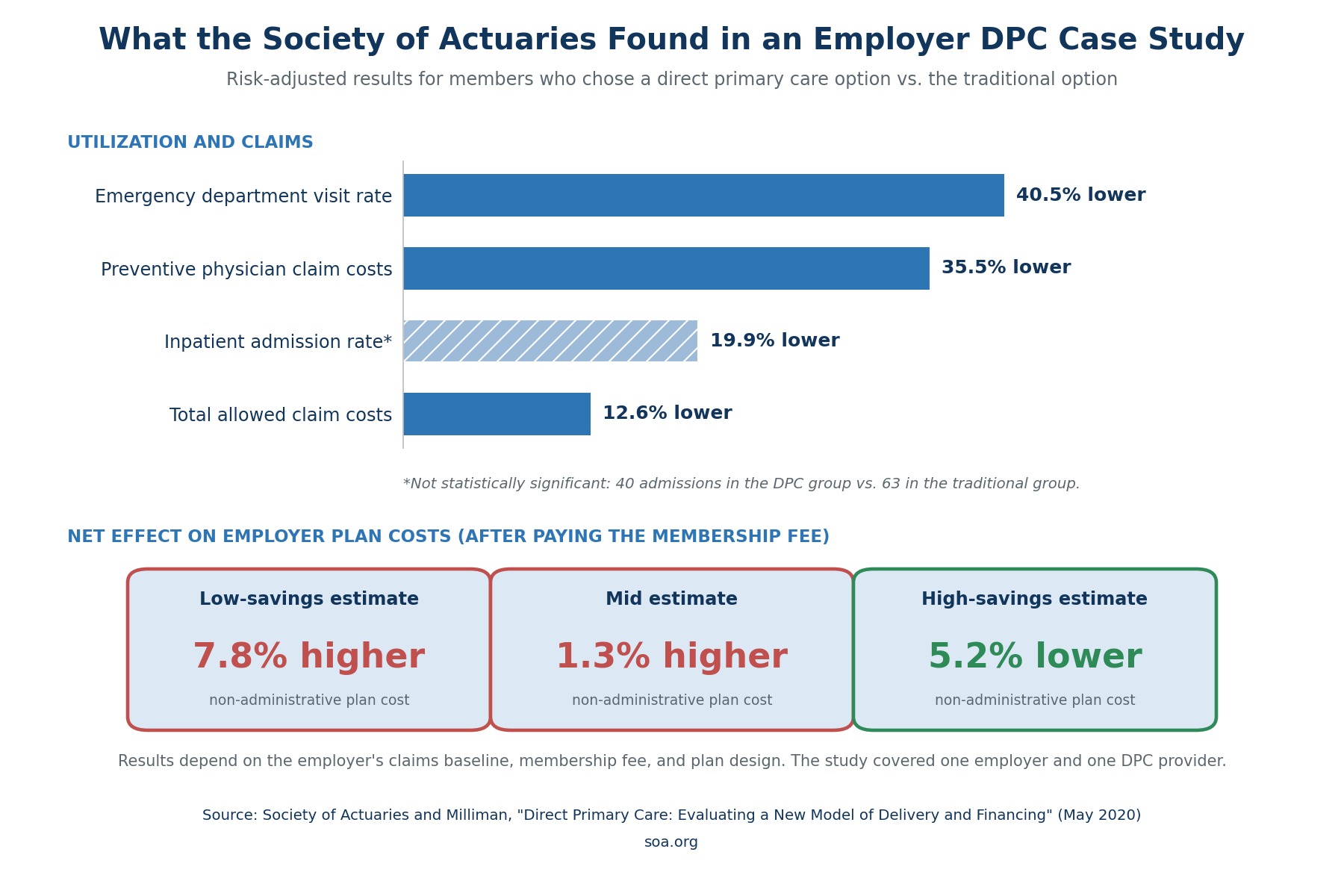
The most widely cited employer study is the 2020 SOA case study. Milliman actuaries analyzed claims from a midsized self-insured employer with roughly 1,000 employees and 1,000 dependents. About half chose a DPC option, and the employer paid the membership fee. The researchers adjusted the results for differences in age, gender, and health status between the two groups.
Utilization and Claims Findings
- Emergency department visits: a 40.51% lower visit rate for DPC members.
- Preventive physician claim costs: 35.51% lower, with the authors noting this may reflect continuous access in place of one scheduled annual physical.
- Total allowed claim costs: 12.64% lower, which the researchers read as lower overall demand for health care services.
- Inpatient admissions: 19.90% lower, but the difference was not statistically significant because admissions were too few to measure reliably.
The Employer Cost Picture, Stated Plainly
Lower claims are only half of the employer math, because the employer also pays the membership fee. After counting that fee and the plan design changes in the study, the researchers estimated a range of outcomes rather than a guaranteed saving.
| Scenario | Change in employer non-administrative plan cost |
|---|---|
| Low-savings estimate | 7.8% higher |
| Mid estimate | 1.3% higher |
| High-savings estimate | 5.2% lower |
The SOA authors concluded that a DPC option can be cost neutral or produce savings depending on three factors: the employer’s baseline claims, how the option is structured including the membership fee, and the savings the care model generates. They also cautioned that the study covered a single employer and a single DPC provider. That honesty is useful in your pitch. HR teams trust a proposal that names its limits.
How to Pitch Direct Primary Care to Your Employer: The Six-Step Plan
A good pitch is short, specific, and easy to approve. Work through these six steps in order.
Step 1: Find Out Who Decides and How the Plan Is Funded
Start by learning who owns benefits decisions at your company. It may be an HR director, a benefits manager, an owner, or a broker. Ask two questions early: is the health plan self-funded or fully insured, and when does open enrollment planning begin? Those answers shape the rest of your approach and tell you how much lead time you have.
How to Pitch Direct Primary Care to Your Employer When the Plan Is Fully Insured
The claims findings in the SOA study come from a self-insured employer, where plan costs track claims directly. If your company buys a fully insured plan, premium changes depend on the carrier’s rating, so do not promise a premium reduction. Build the case on access, fewer missed workdays, and a benefit that helps the company compete for talent. Those points hold up under either funding structure.
Step 2: Build a Short Brief Leadership Can Circulate
Decision makers pass documents upward, so give them something worth passing. Keep the brief to one sheet.
What to Include in the Brief
- A two-sentence definition of DPC and how it works alongside major medical coverage.
- The SOA findings, including the cost range, so the numbers are credible.
- The group starting price of $79 per person per month and a note that final pricing depends on scope.
- The employee experience: same-day access when available, direct messaging, and longer visits.
- A request for a specific next step, such as a 30-minute vendor conversation.
Step 3: Lead With Access, Time, and Retention
Open with the benefit employees feel. Fewer half-day absences for routine visits, quicker answers to health questions, and a primary care team that knows each member are all easy to picture. The SOA report notes that employees may have lower absenteeism because DPC appointments can generally be scheduled at almost any time and waits are shorter. In a competitive hiring market, a benefit people actually use also becomes a recruiting asset.
Chronic conditions are another strong angle. Members with ongoing needs benefit from a team that follows through, including chronic condition support such as diabetes management.
Step 4: Propose a Low-Risk Structure
Make it easy to say yes by proposing something small and reversible. Three structures worth proposing are:
- A voluntary option that employees can choose alongside the existing plan.
- An employer-paid or cost-shared membership for a pilot group.
- On-site wellness screenings for eligible employer groups as a first step.
Step 5: Prepare for Objections
Review the objections in the next section and rehearse a short answer to each. Bringing the weakest part of your own case into the conversation before anyone else does builds trust.
Step 6: Follow Up Within 48 Hours
Benefits decisions rarely happen in one meeting. Send a brief recap within two days with your summary attached, and offer to connect HR with a specialist who can answer vendor and enrollment questions. Employers can contact a benefits specialist directly for that conversation.
What EBO MD Offers Employers
EBO MD is a membership-based primary care practice built around direct access, communication, and continuity of care. Many employers pair EBO MD corporate membership options with a major medical plan, so employees use the clinic for most primary care and keep insurance for emergencies, hospitalizations, surgeries, and specialty care. Employer memberships include:
- Unlimited primary care office visits
- Annual wellness exams and prevention planning
- Little to no wait times for many appointment types
- In-office procedures and diagnostic testing when appropriate
- 24/7 access to the care team for guidance and next steps
- On-site employee wellness screenings for eligible employer groups
- DOT physicals for qualifying roles
Group Membership Pricing and Scope
Group membership starts at $79 per person per month. Prescriptions and services outside the membership are priced transparently, so employees can make informed decisions without guessing. Compare published lab prices with what you pay today, and review membership and pricing details to see how individual enrollment differs from a group arrangement.
How Enrollment Rolls Out
- Fit and scope: confirm eligibility, headcount, locations, and what the team needs most, such as access, screenings, DOT physicals, or chronic support.
- Launch plan: receive a rollout path for employee communications, onboarding, and using the membership from day one.
- Ongoing support: employees use EBO MD as their primary care home with consistent access and follow-through.
Employees also get telehealth visits for quick questions, plus broader primary care services covering everyday needs. With a single electronic health record across locations, members stay connected to one care team. Members can also use lab services when their care plan calls for testing.
Direct Primary Care and Your HSA in 2026
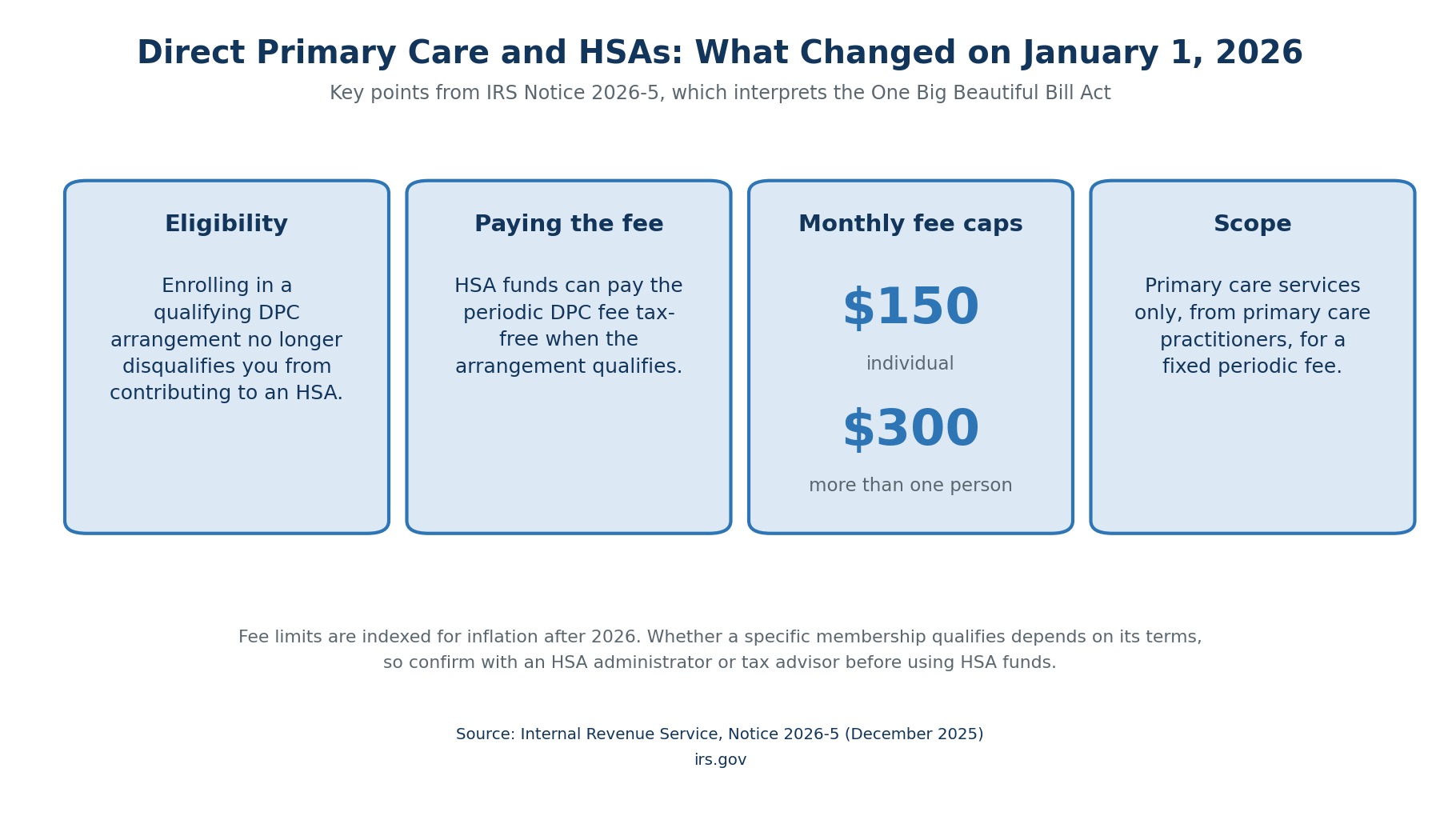
Until this year, tax rules forced a choice for many workers: join a DPC practice or keep an HSA. That changed on January 1, 2026. Under the One Big Beautiful Bill Act and IRS Notice 2026-5, enrolling in a qualifying direct primary care arrangement no longer disqualifies an otherwise eligible person from contributing to an HSA, and HSA funds can pay the periodic fee. Read the IRS announcement on new HSA tax benefits for the official summary.
- The monthly fee limit is $150 for one person and $300 when the arrangement covers more than one person.
- The arrangement must provide primary care services from primary care practitioners for a fixed periodic fee.
- Those limits are indexed for inflation after 2026.
The $79 group starting price sits well below the monthly limit, which is a helpful talking point. Eligibility still depends on how a specific arrangement is structured, so ask your HSA administrator or a tax advisor to confirm before anyone uses HSA funds.
Source: Internal Revenue Service, Notice 2026-5
Answering Common Employer Objections
“We Already Pay for Health Insurance”
Explain that DPC sits beside insurance. The membership covers everyday primary care at a known monthly price, while the major medical plan keeps doing the job it was built for. Employees keep their coverage for emergencies, hospital stays, and specialty care.
“This Will Add Work for HR”
Point to the rollout. The employer receives a launch plan, employee onboarding guidance, and a clear scope up front, so HR is not left to design the program alone. Offer to schedule the vendor conversation yourself.
“Will It Lower Our Premiums?”
Answer honestly. The SOA study found a range of results, and savings were most plausible for self-insured employers with the right structure. Say that you are proposing a benefit with access and retention value, and that HR can model the cost with real claims data.
“Is the Evidence Strong Enough?”
Acknowledge the limits. The best-known study covers one employer and one provider, and critics argue that healthier people tend to choose DPC. The researchers addressed that by adjusting for health status, and the emergency department and total claims results held after adjustment. A small pilot lets your employer test the model with its own workforce.
Four Clinic Locations for Employees
Close locations make a benefit easier to use, which matters for utilization and missed work. Employees can choose the clinic nearest to home or work:
| Clinic | Address | Phone |
|---|---|---|
| Cape Girardeau primary care clinic | 1417 N Mount Auburn Road, Upper Level, Cape Girardeau, MO 63703 | 573-803-2941 |
| Jackson primary care clinic | 1334 Indian Parkway, Jackson, MO 63755 | 573-243-0750 |
| Fredericktown primary care clinic | 605 Lincoln Dr, Fredericktown, MO 63645 | 573-561-5051 |
| Poplar Bluff primary care clinic | 2725 North Westwood Boulevard, Ste 4, Poplar Bluff, MO 63901 | 573-872-4171 |
What to Bring to the Meeting
- A short email or message that proposes a conversation about adding DPC to the benefits lineup.
- Your one-sheet brief with the SOA findings, the cost range, and the $79 starting price.
- A suggested pilot structure, so the decision feels small and reversible.
- Questions HR can answer quickly, such as funding type, enrollment timing, and budget cycle.
Stay collaborative throughout. You are not arguing against the current plan. You are proposing an addition that serves employee health and the company’s finances, and that framing keeps the conversation productive even when the timeline stretches.
Frequently Asked Questions About Pitching DPC to an Employer
What is the best way to ask my employer about direct primary care?
Request a short meeting with HR or your benefits manager, bring a brief summary of the Society of Actuaries research, and propose a voluntary option or a small pilot group. Lead with access, time away from work, and recruiting value, then ask HR to model costs with the company’s own claims data.
Does direct primary care replace health insurance?
No. Direct primary care covers day-to-day primary care for a fixed monthly fee. Most employers pair it with a major medical plan that handles emergencies, hospitalizations, surgeries, imaging, and specialty care.
How much does an employer direct primary care membership cost?
EBO MD group membership starts at $79 per person per month. Final pricing depends on employer scope and implementation needs, so employers should request a quote to see what applies to their workforce.
Can I use my HSA to pay for direct primary care?
Since January 1, 2026, enrolling in a qualifying direct primary care arrangement no longer disqualifies a person from contributing to an HSA, and HSA funds can pay qualifying fees up to $150 per month for one person or $300 per month for more than one person. Whether a specific membership qualifies depends on its terms, so confirm with your HSA administrator or a tax advisor.
Will direct primary care lower my employer’s health costs?
It depends on the employer. In the Society of Actuaries case study, net plan costs ranged from 7.8% higher to 5.2% lower depending on the assumptions, with the mid estimate 1.3% higher. The strongest case combines possible claims effects with better access, fewer missed workdays, and a benefit that helps with hiring and retention.
What happens if an employee needs a specialist or the emergency room?
Employees use their health insurance for emergencies, hospitalizations, surgeries, imaging, and specialty care. The EBO MD care team remains their primary care home and helps guide next steps.
Does EBO MD offer on-site screenings or DOT physicals for employers?
Yes. On-site employee wellness screenings are available for eligible employer groups, and DOT physicals are available for qualifying roles. Employers can ask about scheduling and requirements through the employer inquiry form or by contacting the team.
Take the Next Step Toward Better Workplace Healthcare
A strong pitch pairs your own experience with credible research and a proposal that is easy to approve. Bring the SOA findings, the group pricing, and an open mind about structure, and walk in as a partner rather than a petitioner. When your employer is ready to talk numbers, EBO MD can walk through scope, pricing, and rollout for your workforce.