
What Happens at a Sports Physical: A Parent’s Guide to Safe Play Primary Care
A sports physical is a quick, focused health check, not a test your child can fail. If you are wondering what happens at a sports physical, the short version is this: a provider reviews your athlete’s health history, checks vitals and vision, examines the heart, lungs, and joints, and then decides whether your child can play fully, play with limits, or needs a little follow-up first. Knowing the routine ahead of time takes the stress out of it for both of you.
The visit is designed to answer one question: is there anything going on that hard exercise could make dangerous? For the vast majority of young athletes, the answer is no, and the paperwork is signed that day. When something does turn up, it is usually the start of a simple plan. Families who want a provider who already knows their child can get to know EBO MD before the season starts.
What Happens at a Sports Physical From Start to Finish
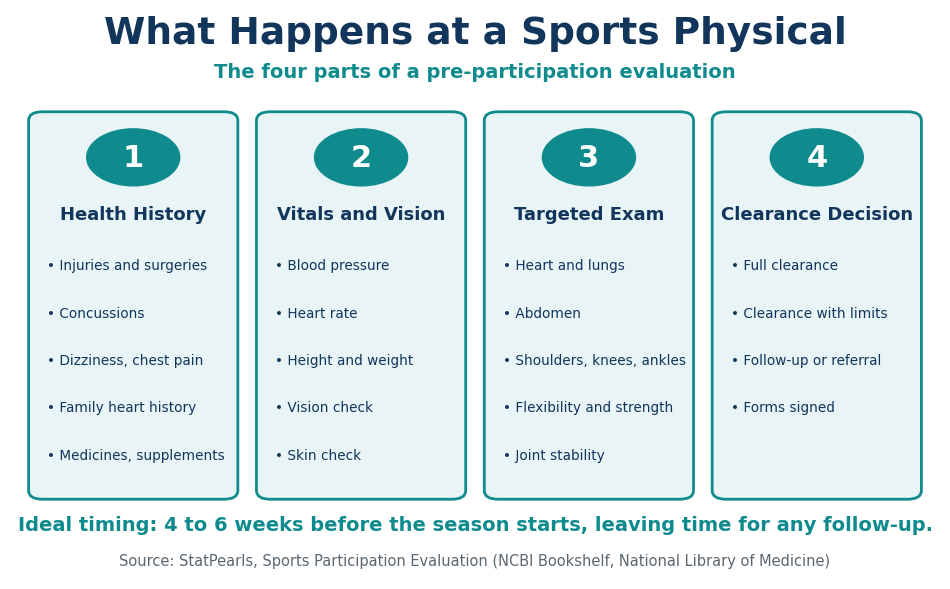
Every pre-participation evaluation follows the same basic order. Think of it as a tune-up before a long road trip: the provider checks the essentials so nothing derails the season.
Source: StatPearls, Sports Participation Evaluation, National Library of Medicine.
Step 1: The Health History
The visit opens with a conversation. According to StatPearls, the athlete’s personal and family history identifies most of the conditions that limit participation or call for more evaluation, which is why this part matters more than any piece of equipment. Expect questions about:
- Past injuries, surgeries, and any time your child was held out of play
- Concussions and how long symptoms lasted
- Dizziness, fainting, palpitations, or chest pain or unusual shortness of breath during exercise
- Family history of unexplained sudden death before age 50, heart rhythm problems, or inherited heart conditions
- Current medications, supplements, and any recent serious illness
- Menstrual history for female athletes
Immunizations come up too. Sports involve shared travel, water bottles, and equipment, so the provider makes sure routine vaccines are current, including seasonal vaccines when they apply.
Step 2: Vitals, Vision, and the Hands-On Exam
Next comes the physical exam, which begins with vital signs and then targets the heart, lungs, joints, and nervous system. A typical visit includes:
| What Is Checked | Why It Matters |
|---|---|
| Blood pressure and heart rate | Elevated blood pressure is noted, and a very low resting heart rate is usually normal in fit athletes but can occasionally signal poor nutrition. |
| Height, weight, and BMI | Helps spot rapid weight changes, including unhealthy weight cutting or an eating disorder. |
| Vision | Protective eyewear is recommended when best-corrected vision is worse than 20/40, especially for sports like basketball. |
| Heart and lungs | Listening for murmurs, irregular rhythms, or wheezing that may point to poorly controlled asthma. |
| Abdomen and skin | Checks for organ enlargement and for contagious skin infections that matter in contact sports and shared equipment. |
| Shoulders, knees, and ankles | Range of motion, strength, and stability in the joints most often injured in sports. |
None of it is uncomfortable. For most athletes it feels like a more targeted version of a routine checkup.
Step 3: The Clearance Decision
At the end, the provider recommends full clearance, clearance with limitations, or no participation for now. StatPearls notes that most healthy young athletes are fully cleared, and that permanent exclusion from all sports is unusual. If your athlete has a concern, the provider explains it and lays out the next step.
What to Expect at a Sports Physical: What the Provider Is Looking For
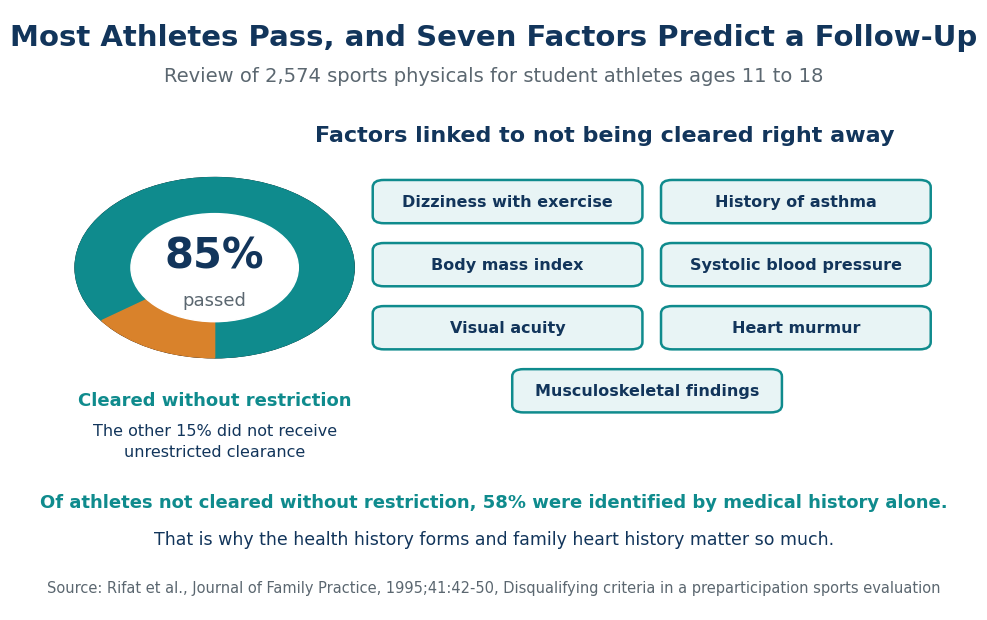
The exam is built to catch the few things that could make exercise risky, not to keep kids on the bench. Decades of research on these exams point to a short list of findings that matter most.
Source: Rifat et al., Journal of Family Practice, 1995, review of 2,574 sports physicals for athletes ages 11 to 18.
In that review, 85% of student athletes passed the screening without restriction. Seven items were linked to not being cleared right away: dizziness with exercise, a history of asthma, body mass index, systolic blood pressure, vision, a heart murmur, and musculoskeletal findings. Among athletes who were not cleared without restriction, the medical history alone led to the decision 58% of the time. That is a strong reason to fill out the history carefully and to share family heart history honestly.
Heart Screening and the ECG Question
Cardiovascular screening is the core of the exam. The provider listens for murmurs and irregular rhythms and asks about fainting, chest pain, and family history. StatPearls notes that sudden cardiac arrest is rare in athletes, at fewer than one per 100,000 athlete-years, and that electrocardiograms and echocardiograms are not indicated when an athlete has no symptoms and no concerning history. Extra testing in healthy athletes can produce false alarms that lead to costly, stressful follow-up. When a real concern appears, the provider can order testing or refer to a specialist.
Concussion and Injury History
Prior head injuries get specific attention, including how long symptoms lasted and whether the athlete was formally cleared before returning to play. Teens sometimes report headaches, poor sleep, trouble concentrating, or fatigue with no history of a blow to the head. Documenting your athlete’s normal baseline now makes it easier to tell the difference if a concussion happens later. Old injuries get reviewed as well, because a knee or shoulder that never fully recovered is a common starting point for the next injury.
The Conversations Beyond Clearance
The American Academy of Pediatrics suggests using the visit to ask about stress and pressure, mood, substance and tobacco use, supplements or products meant to change weight, and whether the athlete feels safe at home. Those conversations are far more likely to happen in a private exam room than at a crowded screening table, where time and privacy are limited.
What Happens at a Sports Physical When a Concern Is Found
A finding is not a disqualification. A newly noticed wheeze, a blood pressure reading that needs rechecking, or a stiff knee usually leads to a follow-up plan: an updated prescription, a referral for a single consultation, or a targeted rehab program before the season. When labs or imaging make sense, EBO MD coordinates them through diagnostic testing so you are not sent elsewhere with a vague instruction to follow up.
Sports Physicals for Different Age Groups
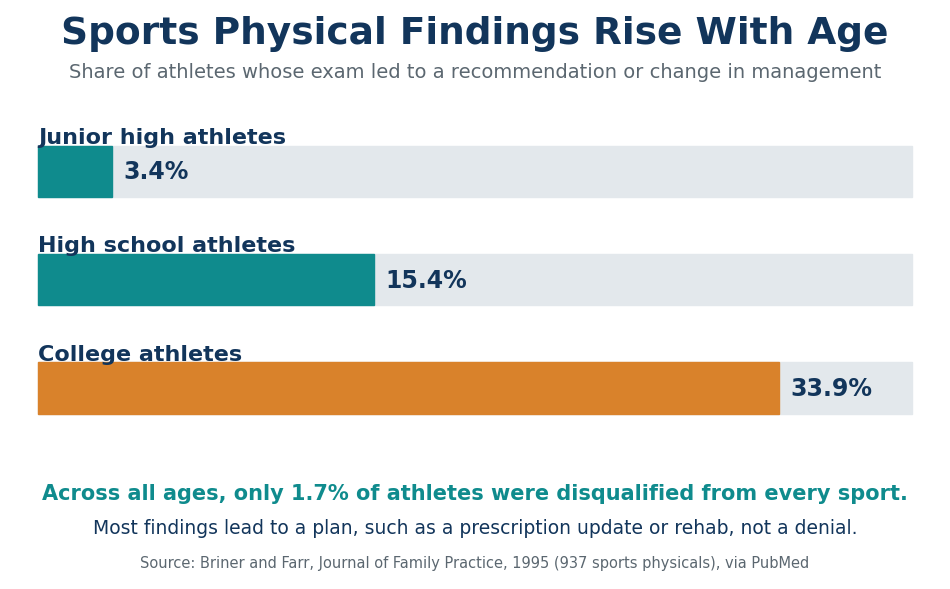
The exam looks different as athletes move from middle school to college. StatPearls notes that an evaluation is usually required at each new school level, with yearly updates in between.
Source: Briner and Farr, Journal of Family Practice, 1995, analysis of 937 sports physicals.
In that analysis, significant findings appeared in 3.4% of junior high athletes, 15.4% of high school athletes, and 33.9% of college athletes, yet only 1.7% of athletes overall were disqualified from every sport, and that rate did not differ by age. Older athletes simply have more accumulated wear, more injuries, and more complex histories.
Middle School Athletes
The focus is growth, coordination, and any condition that has not been noticed yet. The history review often surfaces details parents did not realize were relevant to sports, such as a past episode of wheezing.
High School Athletes
Joint stability, concussion history, blood pressure, and cardiac symptoms take center stage. This is also the stage when conditions like exercise-triggered asthma are most likely to come to light.
College and Competitive Athletes
Screening shifts toward the cumulative demands of high-volume training, prior injuries, and supplement use. Athletes at this level also benefit from a provider who can follow the same injuries from season to season, like the clinicians on the EBO MD provider team.
How to Prepare for Your Athlete’s Sports Physical
Timing matters more than most families realize. StatPearls identifies four to six weeks before the season as the ideal window. That leaves room to finish any follow-up testing or rehab before the first practice, which a physical done the night before tryouts cannot do.
What to Bring to a Sports Physical
- The completed medical history and any school or league forms
- A list of current medications, supplements, and known allergies
- Notes on past surgeries and significant injuries, including any concussion paperwork
- Glasses or contacts, plus the current prescription
- Names of any specialists your athlete already sees
For Missouri student athletes, the MSHSAA forms procedure has the student and parent or guardian complete the medical history, take it to the provider, and return only the Medical Eligibility Form to the school. MSHSAA guidance has also allowed a physical to stay valid for up to two years, with the provider able to set a shorter period. Rules can change, so confirm current requirements with your athletic director. You can review the association’s own explanation in its physical form background document.
What to Wear to a Sports Physical
Loose, comfortable clothing works best, such as a T-shirt and athletic shorts, because the provider needs to see the shoulders, knees, and ankles move. Athletes who wear glasses or contacts should bring them for the vision check.
Why an Office Visit Works Better Than a Station Screening
Many schools host group screenings with several examiners at separate stations. They are convenient, and StatPearls credits them as time efficient, sports-oriented, and less costly. Their drawbacks are the lack of privacy and the lack of continuity with a provider who knows your child. A study comparing the two formats found that office-based and station-based physicals excluded or referred a similar share of athletes, but for different reasons: vision problems were flagged more often at stations, while musculoskeletal and cardiopulmonary issues were flagged more often in the office.
| Factor | Private Office Visit | Group Station Screening |
|---|---|---|
| Privacy | Private exam room | Shared space |
| Continuity | Provider who knows your child’s history | Usually a new examiner each time |
| Time and cost | Scheduled visit | Fast and often lower cost |
| Follow-up | Testing and referrals arranged by the same provider | Family follows up elsewhere |
| Wider health topics | Time to discuss sleep, nutrition, stress, and training load | Limited by time and privacy |
A provider who sees your child regularly can compare this year’s blood pressure with last year’s, notice a change in a known murmur, and connect a new knee complaint to an injury from two seasons ago. That is the practical value of a primary care relationship over a one-time stop.
Sports Physicals and EBO MD Membership
At EBO MD, sports physicals are included in the monthly membership fee, so there is no separate charge for the exam itself. Membership is $99 per month for adults ages 19 to 64, $75 per month for seniors 65 and older, and $10 per month for children ages 0 to 18 when at least one parent is a member. Tests that must be sent outside the office are priced at negotiated wholesale lab prices. To learn how the model works before joining, read how membership-based care works, or see membership pricing in full. Families ready to schedule can book sports physicals in Southeast Missouri through the clinic nearest them.
Where to Get a Sports Physical
EBO MD has four clinics in Southeast Missouri. Call the location closest to you to ask about availability.
- Sports physicals in Cape Girardeau: 1417 N Mount Auburn Road, Upper Level, Cape Girardeau, MO 63703. Phone: 573-803-2941
- Athletic clearance exams in Jackson: 1334 Indian Parkway, Jackson, MO 63755. Phone: 573-243-0750
- Student athlete physicals in Fredericktown: 605 Lincoln Dr, Fredericktown, MO 63645. Phone: 573-561-5051
- Pre-participation exams in Poplar Bluff: 2725 North Westwood Boulevard, Ste 4, Poplar Bluff, MO 63901. Phone: 573-872-4171
Frequently Asked Questions About Sports Physicals
What questions do they ask at a sports physical?
The history covers concussions and head injuries, dizziness, fainting, or chest pain during exercise, family history of heart conditions or unexplained sudden death before age 50, allergies, medications and supplements, and past surgeries or significant injuries. Female athletes are also asked about menstrual history, since irregular cycles can signal nutrition or bone health concerns.
Is a genital or hernia exam part of a sports physical?
A brief genitourinary check can be part of the exam. One reason is to identify a solitary testis, which calls for a protective cup in contact sports. The provider explains what is included before starting, and parents are welcome to ask questions about it beforehand.
What should my child wear to a sports physical?
Loose, comfortable clothing such as a T-shirt and athletic shorts works well. The provider needs to watch the shoulders, knees, and ankles move through their range of motion, and your athlete should bring glasses or contacts for the vision check.
Can my child fail a sports physical?
It is not a pass-or-fail test. Most healthy young athletes are fully cleared. When something is found, it usually leads to a follow-up plan or clearance with limits, and permanent exclusion from all sports is unusual.
Does a sports physical include an ECG?
Not routinely. Electrocardiograms and echocardiograms are not recommended for athletes who have no symptoms and no concerning history, because they can cause false alarms. The provider orders one when the history or exam raises a concern.
How often does an athlete need a sports physical?
An evaluation is usually required at each new school level, with yearly updates in between. In Missouri, MSHSAA guidance has allowed a physical to remain valid for up to two years, but the provider can set a shorter period, so confirm the current requirement with your school.
Is a sports physical the same as an annual physical?
No. A sports physical is focused on finding problems that could cause serious complications during play, and it is not intended to replace a comprehensive well visit. At EBO MD, both the annual physical and the sports physical are included in the monthly membership fee.
How long does a sports physical take?
It is a short, focused visit. Arriving with the completed history form, medication list, and school paperwork keeps it moving, since the provider can spend the time on the exam instead of filling in forms.
How much does a sports physical cost at EBO MD?
Sports physicals are included in the monthly membership fee. Membership is $99 per month for adults ages 19 to 64, $75 per month for seniors, and $10 per month for children ages 0 to 18 with at least one parent member.
Get Your Athlete Cleared to Play
A sports physical gives your family real confidence heading into a new season, and it works best with a provider who knows your child’s history and has time to be thorough. Schedule four to six weeks before the season, bring the paperwork, and let the exam do its job: catching the few things that matter and clearing your athlete for everything else.