
Urgent Care vs. Primary Care: Which One Do You Need? Primary Care
Choosing between urgent care vs primary care comes down to timing and relationship. Urgent care treats sudden, non-life-threatening problems on a walk-in basis. Primary care follows your health over time, from yearly checkups to chronic conditions. Direct primary care, the membership model used at EBO MD, is built to cover both needs with fast appointments and a doctor who already knows your history.
Urgent care has become a routine part of how Americans get medical care. In 2024, 27.6 percent of people in the United States had at least one urgent care center visit in the previous 12 months, according to the CDC. This guide compares the two options side by side, explains where each one fits, and shows how a membership-based practice changes the cost and access picture for families in Southeast Missouri.
Urgent Care vs Primary Care: A Side-by-Side Comparison
The two settings overlap on minor illnesses, but they are designed for different jobs. The table below shows how urgent care, traditional insurance-billed primary care, and direct primary care compare on the factors that matter most to patients.
| Factor | Urgent Care | Traditional Primary Care | Direct Primary Care |
|---|---|---|---|
| Best for | Sudden, non-life-threatening problems | Checkups, chronic conditions, ongoing needs | Everyday care, chronic conditions, and sudden illness in one place |
| Relationship | Episodic, often a different clinician each visit | Ongoing, but visits can be short | Ongoing, with time built into each visit |
| Getting seen | Walk-in, with waiting room time | Scheduled in advance, availability varies | Same-day or next-day appointments at EBO MD |
| How you pay | Billed per visit, copay or deductible applies | Billed per visit through insurance | Flat monthly fee, no copay for primary care visits |
| Follow-up | Usually returns to your own doctor | Handled by your doctor | Handled by the same care team that treated you |
| Preventive care | Not the focus | Yes | Annual wellness visit included with membership |
What Urgent Care Does Well
The CDC describes urgent care centers as freestanding facilities designed to treat acute, non-life-threatening injuries and illnesses, and most are staffed by an onsite licensed physician. When your regular doctor is closed or unavailable, that fills a real gap. Common reasons people go include:
- Sprains, strains, and suspected minor fractures that need an x-ray
- Minor cuts that may need stitches
- Sinus infections, urinary symptoms, and sore throats that need quick testing
- Mild allergic reactions and mild respiratory illness
- Evening or weekend problems that cannot wait until Monday
Within that scope, the walk-in model works. It is a good option when you are traveling, when something happens outside normal hours, or when you have no established doctor.
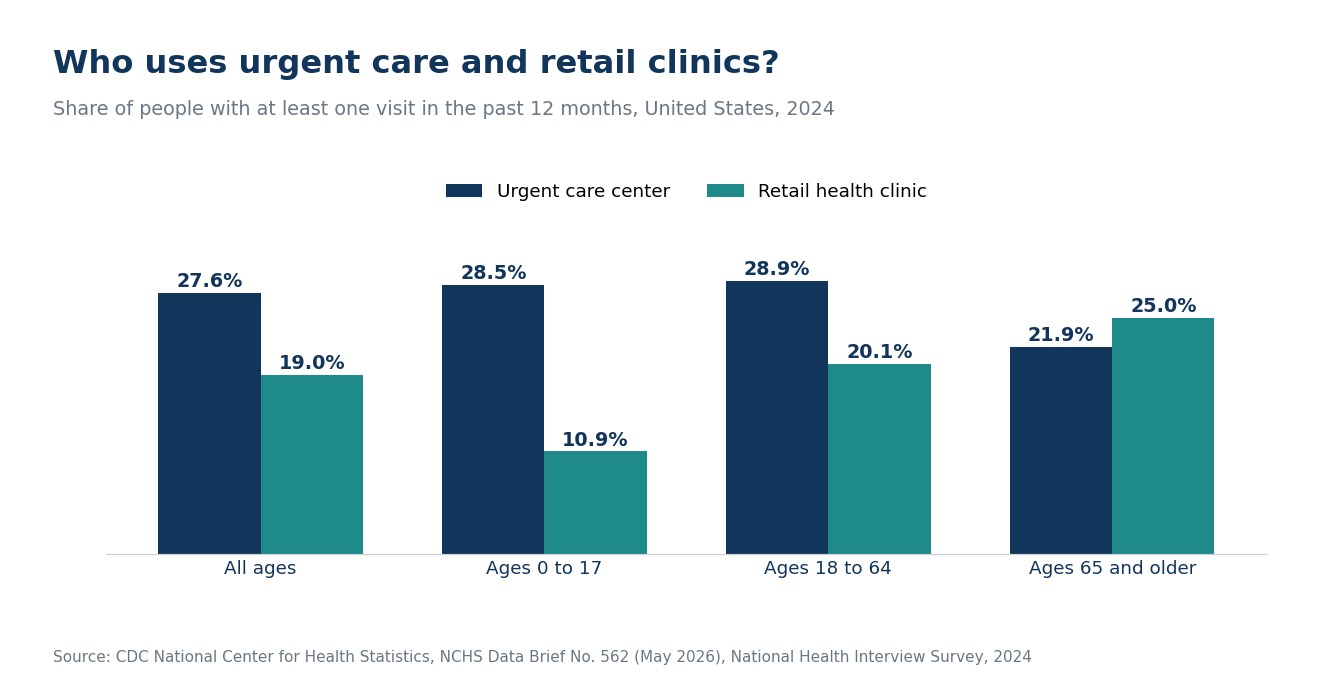
Source: CDC National Center for Health Statistics, NCHS Data Brief No. 562
Where Urgent Care Falls Short
Urgent care is built around a single visit. The clinician treats the problem in front of them and then you leave. That structure makes it hard to monitor blood pressure over months, adjust a medication, or notice that your symptoms are part of a larger pattern. Because the clinician often does not have your full history, medications, and baseline, the visit starts from scratch every time. That is a limit of the model rather than a criticism of the clinicians who work in it.
It also means urgent care cannot take over the work of a regular doctor. Preventive screening, chronic condition management, and long-term planning belong in a continuing relationship.
What Primary Care Does Best
A primary care provider is the person who sees the whole picture. They track your numbers year after year, catch changes early, coordinate referrals to specialists, and treat everyday illnesses without starting over. EBO MD provides ongoing medical care for acute and chronic conditions in a setting where visits are not rushed, and that continuity is where primary care delivers the most value.
Choosing the Right Care for Your Situation
Most decisions are simpler than they feel. A quick check of how urgent the problem is, and whether it is part of something ongoing, points to the right first stop.
How to Decide Between Urgent Care vs Primary Care
| Your situation | Best first stop |
|---|---|
| High blood pressure, diabetes, thyroid, or other ongoing condition | Primary care |
| Annual physical, school or sports physical, preventive labs | Primary care |
| Cold, flu symptoms, sore throat, ear pain, or a rash | Primary care if you can be seen today or tomorrow, otherwise urgent care |
| Minor sprain or injury during business hours | Primary care for evaluation, with x-ray if needed |
| Minor injury at night or on a weekend while traveling | Urgent care |
| Questions about medication, test results, or symptoms | Primary care by phone, message, or telehealth |
| Chest pain, trouble breathing, stroke signs, severe bleeding | Emergency room |
If you already have a doctor who can see you quickly, that doctor is usually the better first call. They know your history, so the advice they give fits you rather than a generic patient.
When the Emergency Room Is the Right Choice
Some situations are beyond what urgent care or an office can safely handle. Call 911 or go to the nearest emergency room for chest pain, difficulty breathing, signs of a stroke, severe bleeding, a serious head injury, or any condition you believe is life-threatening. In 2022, the United States recorded an estimated 155 million emergency department visits, a rate of 47 visits per 100 people, according to the CDC. Access to a doctor who can see you quickly helps keep minor problems from defaulting to the emergency room.
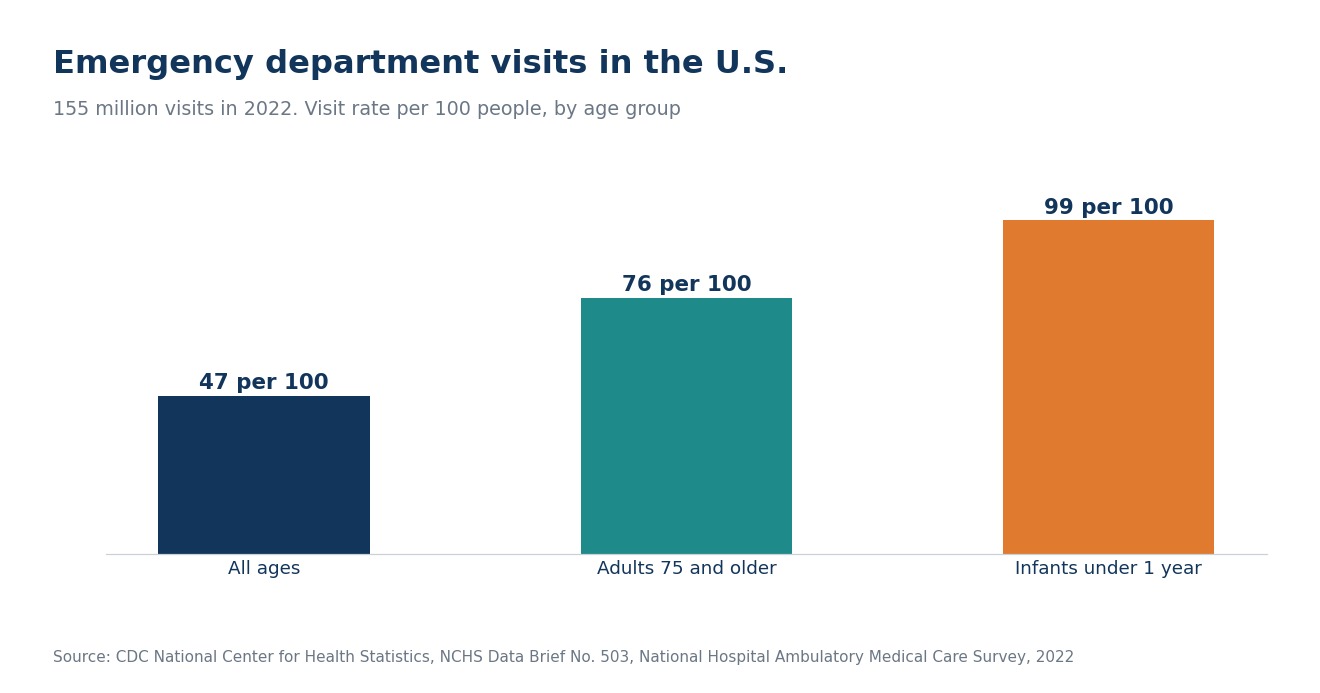
Source: CDC National Center for Health Statistics, NCHS Data Brief No. 503
How Direct Primary Care Changes the Equation
The American Academy of Family Physicians describes direct primary care as a payment model in which patients pay their physician or practice directly, through periodic payments, for a defined set of primary care services. There is no per-visit billing to an insurance company for those services. That payment structure is what makes the rest possible: smaller patient lists, longer visits, and direct access to your doctor.
Faster Access When You Are Sick
The most common reason people end up at urgent care is that they could not get in to see their own doctor. EBO MD limits the number of patients in the practice so members can be seen the same day or, at worst, the next day. After hours, members can reach a physician by phone, email, or messaging through telehealth access, which often resolves a question without a trip anywhere.
Predictable Monthly Costs
Under fee-for-service billing, each visit generates its own charge, and what you owe depends on your deductible and copay. With membership, the cost is a flat monthly fee. Here are current monthly membership rates at EBO MD:
| Member type | Monthly rate |
|---|---|
| Adult (ages 19 to 64) | $99 |
| Child (ages 0 to 18, with at least one parent member) | $10 |
| Senior (age 65 and older) | $75 |
Membership includes unlimited office visits for primary care needs, an annual wellness exam, and acute illness and minor injury visits, with no copay. There is no sign-up fee. EBO MD asks for a minimum 90-day membership and 30 days of written notice to cancel, and all of the details are laid out before you enroll. You can see how enrollment and scheduling work before you decide.
A Doctor Who Knows Your History
Continuity may matter more than most people realize. A systematic review in BMJ Open examined 22 studies from nine countries and found that 18 of them linked higher continuity of care with lower mortality. The evidence is observational, so it shows an association rather than proof of cause, but it supports the idea that having one doctor who knows you over time is a medical advantage and not only a convenience.
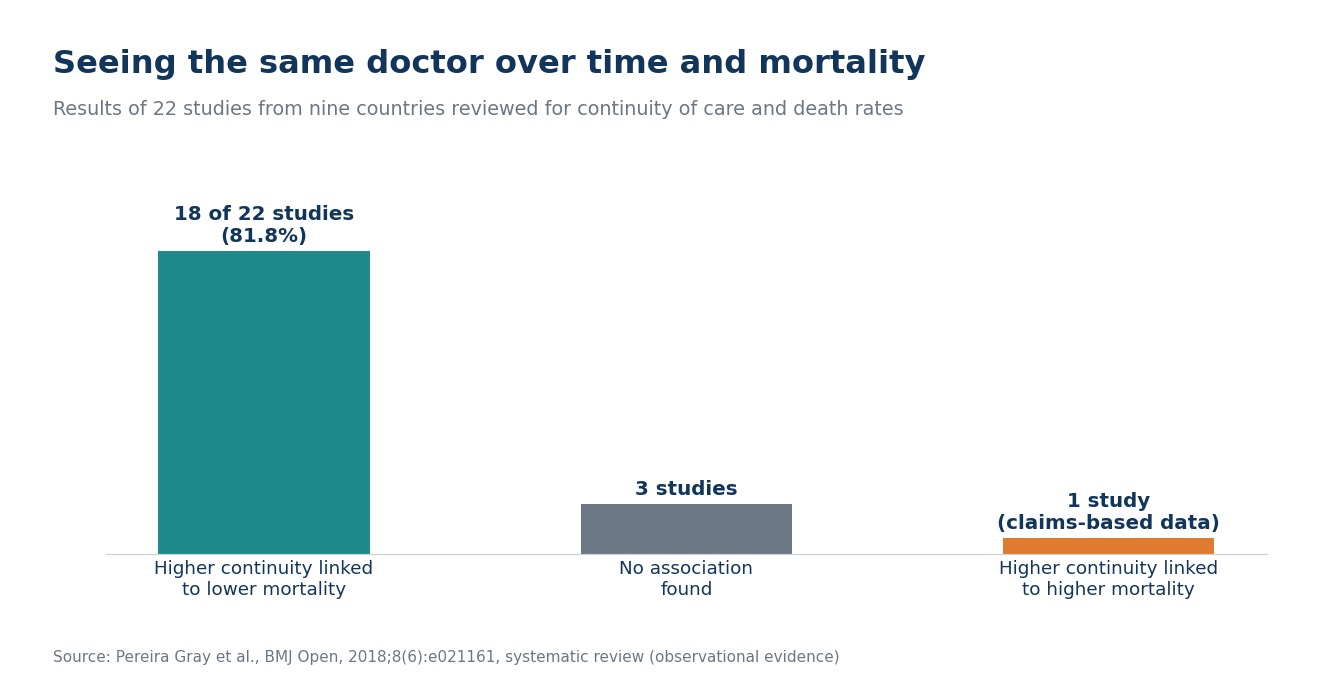
Source: Pereira Gray et al., BMJ Open, 2018
What EBO MD Members Handle Without a Trip to Urgent Care
EBO MD is a membership-based practice with four clinics in Southeast Missouri. Because the membership covers what happens in a typical primary care office, many problems that send people to urgent care can be handled by your own care team, including:
- Acute illness visits, such as colds, flu symptoms, ear infections, and sore throats
- Minor injury evaluation
- In-office testing for common conditions
- Chronic condition monitoring and medication management
- Annual wellness visits and preventive planning
- Nursing home visits for patients who need them
Quick testing is available for same-visit testing for common infections, so you leave with an answer and a plan. When an injury needs a closer look, affordable on-site x-rays are available at the Cape Girardeau clinic for $65 for members and $75 for non-members, including radiologist interpretation, and no referral is required.
For ongoing needs, the same team provides diabetes management support and sports and school physicals included in the monthly fee. Members can also access basic in-office procedures when a visit calls for them.
Labs that must be sent out are not part of the monthly fee, but members receive negotiated wholesale lab rates with no markup, and members can fill generic medications dispensed in the office at wholesale prices. If you need a medication the clinic does not dispense, you pay your pharmacy as you normally would.
Keep Insurance for the Big Events
Direct primary care is not health insurance. EBO MD encourages members to keep some level of coverage for hospital stays, specialist care, imaging outside the clinic, and emergencies. EBO MD recommends a high-deductible plan, a major medical plan, or a plan with a health savings account, since everyday primary care is covered by the monthly fee and insurance is there for larger events. If you have questions about how your plan works with membership, your insurance provider can answer them directly. Medicare patients can join as well, though the membership fee cannot be submitted to Medicare for reimbursement.
Visit an EBO MD Clinic Near You
EBO MD serves patients across the Cape Girardeau region and Southeast Missouri through four Southeast Missouri clinics. Each clinic operates under the same membership model, so the experience and access are consistent. Choose the clinic that is easiest for you to reach, or contact the care team if you want help picking one.
| Clinic | Address | Phone |
|---|---|---|
| Cape Girardeau clinic | 1417 N Mount Auburn Road, Upper Level, Cape Girardeau, MO 63703 | 573-803-2941 |
| Jackson clinic | 1334 Indian Parkway, Jackson, MO 63755 | 573-243-0750 |
| Fredericktown clinic | 605 Lincoln Dr, Fredericktown, MO 63645 | 573-561-5051 |
| Poplar Bluff clinic | 2725 North Westwood Boulevard, Ste 4, Poplar Bluff, MO 63901 | 573-872-4171 |
Frequently Asked Questions About Urgent Care and Primary Care
What is the difference between urgent care and primary care?
Urgent care treats sudden, non-life-threatening problems such as sprains, minor cuts, and common infections, usually on a walk-in basis. Primary care is an ongoing relationship with a doctor who handles preventive care, chronic conditions, and illnesses over time, so each visit builds on the last.
Can I use both direct primary care and urgent care?
Yes. Membership does not stop you from using urgent care when you are traveling or when something happens and you cannot reach your care team. Because EBO MD offers same-day or, at worst, next-day appointments and after-hours telehealth access, most everyday needs can be handled by your own care team first.
Do I need insurance to join EBO MD?
No. Insurance is not required for membership, but EBO MD encourages members to keep some level of coverage for hospital care, specialist visits, imaging outside the clinic, and emergencies. Membership does not replace insurance.
Is direct primary care cheaper than urgent care?
It depends on how often you need care and what your insurance plan charges. Urgent care bills each visit separately, while membership is a flat monthly fee that covers unlimited office visits for primary care needs, with no copay. Comparing the monthly fee with what you typically pay in copays and deductible costs over a year is the best way to judge.
When should I go to the emergency room instead?
Call 911 or go to the nearest emergency room for chest pain, trouble breathing, signs of a stroke, severe bleeding, a serious injury, or any condition you believe is life-threatening. Neither urgent care nor primary care replaces emergency care.
Does EBO MD offer same-day appointments?
EBO MD limits the number of patients in the practice to keep same-day or, at worst, next-day appointments available. Members can also reach a physician after hours through telehealth by phone, email, or messaging.
Can my children join EBO MD?
Yes. Children from birth through age 18 can be members when at least one parent is a member. The child rate is $10 per month.
Get a Doctor Who Knows You Before You Need One
The best time to build a relationship with a doctor is before you are sick. A care team that knows your history can spot problems earlier, manage chronic conditions, and answer questions quickly, which means fewer rushed decisions at a walk-in counter. With predictable monthly pricing and direct access to your doctor, membership makes it easier to get the care you need when you need it.
This article is for general education and does not replace individual medical advice.
EBO MD is not insurance coverage. We encourage patients to maintain some level of health insurance to help cover the costs of medical care that they receive from medical providers or facilities outside our practice.
If you have questions about how your existing insurance policy will work with direct primary care, contact your insurance provider.