
Flu vs Strep Throat: How to Tell the Difference Health News
Sudden fever, a painful throat, and a body that aches all over can point to two very different illnesses. The flu vs strep question matters because one is caused by a virus and the other by bacteria, and the treatment that helps one does nothing for the other. The clearest early clue is cough: flu commonly brings one, while strep throat typically does not.
Even so, symptoms alone rarely settle it. Fever, headache, and a sore throat can show up with either infection, and most sore throats turn out to be something else entirely. A quick swab at EBO MD gives you a confirmed answer, so your treatment matches the infection instead of a guess.
Flu vs Strep: Symptoms Side by Side
Influenza and group A strep both hit hard and fast, which is why people confuse them. The difference is where the illness concentrates. Flu affects the whole body. Strep throat concentrates its misery in the throat and tonsils.
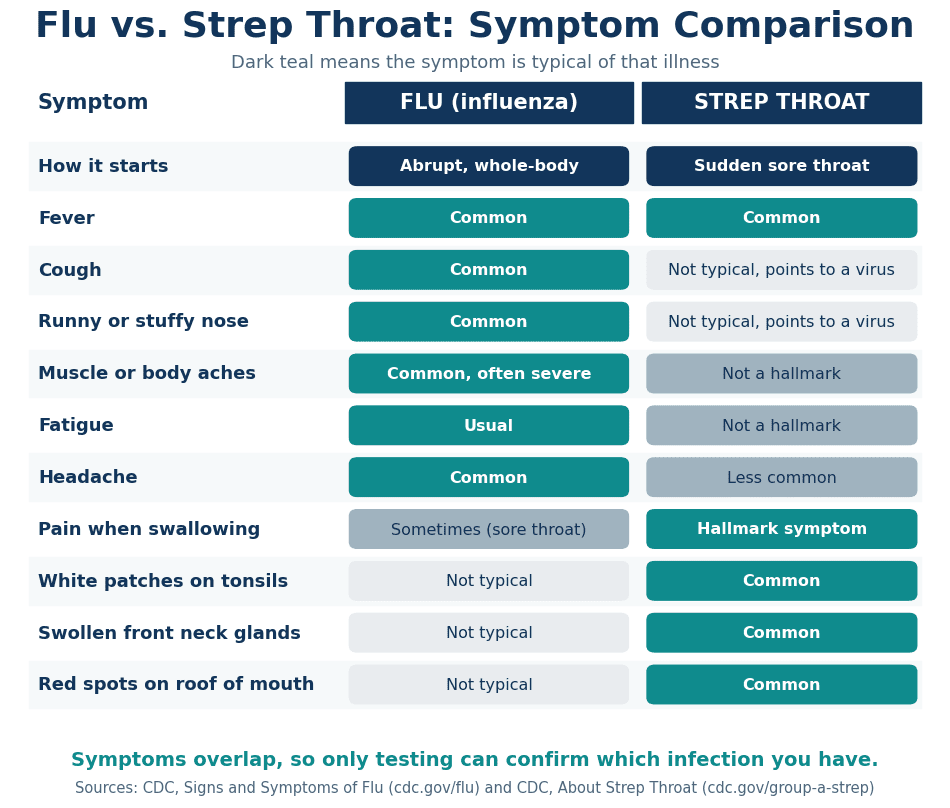
Source: Centers for Disease Control and Prevention, Signs and Symptoms of Flu and About Strep Throat.
How Flu Symptoms Typically Show Up
According to the CDC, flu symptoms usually come on suddenly. Many people feel fine in the morning and flattened by evening. Common signs include:
- Fever or feeling feverish, often with chills (not everyone with flu runs a fever)
- Cough
- Sore throat
- Runny or stuffy nose
- Muscle or body aches
- Headache
- Deep fatigue
- Vomiting and diarrhea, which are more common in children than adults
The body aches and exhaustion are what set flu apart from a cold. If you are dealing with that combination plus a fever, a flu test in Missouri can confirm influenza while antiviral treatment is still worth considering.
How Strep Throat Symptoms Typically Show Up
Strep throat is a bacterial infection of the throat and tonsils caused by group A Streptococcus. The CDC notes that it usually takes 2 to 5 days after exposure to become ill. The hallmark signs are:
- A sore throat that started very quickly and may look red
- Pain when swallowing
- Fever
- Red, swollen tonsils, sometimes with white patches or streaks of pus
- Swollen lymph nodes in the front of the neck
- Tiny red spots on the roof of the mouth, called petechiae
Headache, nausea, vomiting, and stomach pain can also occur, especially in children, and a sandpaper-like rash signals scarlet fever. What strep usually leaves out is just as telling. Cough, runny nose, hoarseness, and pink eye all point toward a virus instead.
Flu vs Strep in Children and Adults
Age changes the odds. Strep throat is far more common in children than adults, and the CDC lists ages 5 through 15 as the most common range, with cases in children under 3 being rare. Close contact is the biggest risk factor, so parents of school-age children and adults who spend time around kids catch it more often. Flu, by contrast, can affect anyone at any age.

Source: Centers for Disease Control and Prevention, About Strep Throat.
The chart makes an important point: viruses cause most sore throats. Only around 1 in 10 adults and 3 in 10 children with a sore throat actually have strep. That is exactly why a sore throat with a cough and runny nose is rarely worth an antibiotic, and why a sudden, severe sore throat without those cold symptoms deserves a swab.
Why Symptoms Alone Cannot Settle It
Because both illnesses can begin with a fever, a headache, and a painful throat, even an experienced clinician relies on testing rather than a symptom checklist. A few patterns help you decide what to do next.
Strep Throat vs Flu: Clues That Point One Way or the Other
- Leans toward flu: sudden onset with cough, stuffy or runny nose, widespread body aches, and heavy fatigue.
- Leans toward strep: a sore throat that is painful to swallow, swollen tender glands in the front of the neck, white patches on the tonsils, and no cough.
- Leans toward a common cold or other virus: gradual onset, hoarseness, pink eye, and a runny nose alongside a mild sore throat.
These clues shift the odds but do not give a diagnosis. A strep swab can be negative even when the throat looks bad, and a flu test can explain a miserable week that looked like strep. The CDC also notes that viral infections such as flu can raise the risk of serious group A strep infections, which is one more reason to get a confirmed answer rather than assume a single cause. You can read more in the CDC overview of group A strep infections.
How Testing Separates Strep Throat vs Flu
Two different swabs answer two different questions. A throat swab looks for group A strep bacteria. A nasal swab looks for evidence of influenza. Your provider chooses based on your symptoms, your exam, and what else is circulating in your community.
The Strep Swab
A rapid strep test in Missouri takes a quick throat swab and shows within minutes whether group A strep is likely the cause. The CDC explains that providers generally run a rapid test first and then decide whether a throat culture is needed. A culture takes longer, but it sometimes finds infections the rapid test misses. For children and teens, the CDC says a culture is important after a negative rapid test. For adults, it is usually not necessary.
The Flu Swab
A flu test usually uses a nasal swab to collect a respiratory sample. The result is read alongside your symptoms and exam, since influenza symptoms are not specific and other respiratory infections can look the same. When symptoms overlap with other respiratory illness, COVID-19 testing may be added to the workup so nothing is missed.
What the Visit Looks Like
- Symptom review: when it started, whether a cough developed, how high the fever is, and who else at home is sick.
- Exam: your provider checks the throat, tonsils, and neck glands.
- Swab: a throat or nasal swab takes seconds and is not painful.
- Results and plan: the result is reviewed in context, and you leave with a treatment and follow-up plan.
EBO MD runs common tests in the office, and when a test must be sent out, the team coordinates it through lab services at negotiated wholesale lab prices. Patients with less clear-cut symptoms can also be evaluated through broader in-office diagnostic testing.
Treatment: Antibiotics for Strep, Antivirals for Flu
Matching the treatment to the cause is the whole point of testing. Antibiotics fight bacteria and do not work against viruses like influenza, and flu antivirals only work against flu. Taking the wrong one wastes time and, in the case of unnecessary antibiotics, adds to the growing problem of antibiotic resistance.

Source: Centers for Disease Control and Prevention, Treatment of Flu and Testing for Strep Throat or Scarlet Fever.
| Factor | Flu | Strep Throat |
|---|---|---|
| Cause | Influenza virus | Group A Streptococcus bacteria |
| Typical test | Nasal swab | Rapid strep swab, with throat culture when needed |
| Treatment | Prescription antiviral medicine when appropriate | Antibiotics |
| Best timing | Antivirals work best within 1 to 2 days of symptom onset | Antibiotics help you feel better faster and prevent complications |
| Antibiotics help? | No | Yes |
| Return to work or school | Stay home until the fever is gone | No fever and at least 12 to 24 hours of antibiotics |
What to Expect With Flu Treatment
The CDC says flu antivirals are prescription medicines that work best when started within 1 to 2 days after symptoms begin, and that they can shorten illness by about a day. Most healthy people with flu recover with rest and fluids and do not need an antiviral. People at higher risk of complications, including adults 65 and older, pregnant people, young children, and anyone with asthma, diabetes, or heart disease, should contact a provider promptly so the window is not missed.
What to Expect With Strep Treatment
Strep throat is treated with antibiotics, which shorten the illness, ease symptoms, reduce the chance of spreading the bacteria, and prevent serious complications such as rheumatic fever. The CDC advises calling your provider if you are not feeling better after 48 hours on antibiotics. Take the full course exactly as prescribed, even after you start feeling better.
Complications Worth Knowing About
Most cases of both illnesses resolve without lasting trouble, but each has complications that make early evaluation worthwhile.
Untreated Strep Throat
When the bacteria spread beyond the throat, the CDC lists these possible complications:
- Abscesses (pockets of pus) around the tonsils or in the neck
- Ear infections
- Sinus infections
- Post-streptococcal glomerulonephritis, a kidney disease
- Rheumatic fever, a disease that can affect the heart, joints, brain, and skin
Serious Flu Complications
Sinus and ear infections are moderate flu complications, while pneumonia is the most serious common one. Flu can also make chronic conditions such as asthma or heart disease worse. Trouble breathing, bluish lips or face, chest pain, or confusion are warning signs that call for immediate medical care, not a scheduled visit.
Getting Ready for Your Visit
A few minutes of preparation helps your provider sort out the cause faster. Before you come in, jot down:
- The day and time your symptoms started
- Your highest temperature and how long the fever has lasted
- Whether a cough, runny nose, or hoarse voice has developed
- Anyone at home, school, or work who has been diagnosed with strep or flu
- Current medications and any chronic conditions
Members can reach out to the care team with questions before a visit, and acute illness visits are part of a primary care visit for acute illness. Strep testing done in the office is covered by membership. The flu test is not included in membership and carries an additional fee, so it helps to ask about pricing when you call. If you want to understand the model before joining, see how membership-based care works.
Adult membership is $99 per month, children from birth through age 18 are $10 per month with at least one parent member, and seniors 65 and older are $75 per month. Full details are listed in the current membership pricing.
Find Flu and Strep Testing Near You
EBO MD has four clinics in Southeast Missouri. Call the clinic closest to you to ask about availability for a sick visit.
- Flu and strep testing in Cape Girardeau: 1417 N Mount Auburn Road, Upper Level, Cape Girardeau, MO 63703. Phone: 573-803-2941
- Sore throat and flu care in Jackson: 1334 Indian Parkway, Jackson, MO 63755. Phone: 573-243-0750
- Rapid strep testing in Fredericktown: 605 Lincoln Dr, Fredericktown, MO 63645. Phone: 573-561-5051
- Flu testing in Poplar Bluff: 2725 North Westwood Boulevard, Ste 4, Poplar Bluff, MO 63901. Phone: 573-872-4171
Frequently Asked Questions About Flu vs Strep
What is the main difference between flu and strep throat?
Flu is a viral infection, while strep throat is a bacterial infection. Flu usually brings a sudden fever, cough, body aches, and fatigue. Strep throat concentrates in the throat, causing severe pain when swallowing, swollen tonsils, and tender neck glands, typically without a cough or runny nose.
Can you have the flu and strep throat at the same time?
Yes, it can happen. The CDC notes that viral infections such as flu can increase the risk of serious group A strep infections. When symptoms are severe or keep getting worse, testing for both is a sensible way to avoid treating only half of the problem.
What does day 1 of strep throat look like?
Strep usually starts with a sore throat that comes on very quickly, pain when swallowing, and often a fever. Visible signs such as white patches or swollen glands may not have developed yet on the first day. A sudden, severe sore throat without cough or runny nose is enough reason to get tested.
What gets commonly mistaken for strep throat?
Viral sore throats from colds and flu are the most common look-alikes, since viruses cause most sore throats. Other infections such as mononucleosis can also cause throat pain, swollen tonsils, and fever. Cough, runny nose, hoarseness, and pink eye suggest a virus rather than strep.
How do you rule out strep throat?
Providers combine an exam with a rapid strep test and, when needed, a throat culture. The CDC says a culture is important after a negative rapid test in children and teens, while adults usually do not need one. A negative culture means antibiotics are not needed.
Will strep throat go away without antibiotics?
Antibiotics are the recommended treatment. They shorten the illness, ease symptoms, reduce spread to others, and lower the risk of complications such as rheumatic fever. Skipping treatment and hoping it resolves on its own is a gamble that can have effects lasting well beyond the sore throat.
How quickly should I get a flu test?
As soon as possible after symptoms begin. Flu antivirals work best when started within 1 to 2 days of symptom onset, so waiting several days can close the window for treatment. People at higher risk of complications should contact a provider right away.
Are flu and strep tests covered by EBO MD membership?
Strep testing that can be done in the office is covered by membership. The flu test is not included in membership and carries an additional fee. Tests that must be sent out are coordinated at wholesale lab prices.
Get the Right Diagnosis and the Right Treatment
A fever and a painful throat should not leave you guessing. Testing separates flu from strep, points you toward the treatment that actually works, and tells you when it is safe to get back to work and school. EBO MD pairs fast in-office testing with a provider who knows your health history, so unclear symptoms get a clear plan.